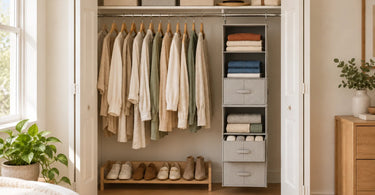
A small closet rarely fails because it's small. It fails because the space inside it isn't working. Most reach-in closets in American homes are about 24 inches deep and somewhere between 3 and 8 feet wide. That's more room than it feels like. A single rod at the standard height leaves a tall, empty column of air beneath your shirts. The top shelf collects whatever didn't fit anywhere else. The floor becomes a shoe pile.
The fix isn't a renovation. It's a sequence: decide what belongs there, measure what you have, then give every item a specific place. Here's a nine-step method that works in almost any reach-in closet, in the order that saves the most time.
Empty it completely, then edit
Take everything out. Yes, everything. You can't plan a space you can't see, and putting each piece back is the moment you decide whether it earns its spot.
Sort as you go into four piles:
- Keep here: clothes you've worn in the last season and plan to wear this one.
- Store elsewhere: off-season clothing, spare bedding, and anything you use a few times a year.
- Donate or sell: things that don't fit, don't suit you, or haven't been worn in a year.
- Repair: the missing button, the loose hem. Give yourself two weeks, or move it to donate.
The "store elsewhere" pile is where small closets win. A winter coat and a stack of wool sweaters can take up a third of a reach-in closet in July. Moving them under the bed or into a breathable storage bag often frees more space than any organizer. (We cover how in our guide to the best ways to store blankets — the same rules apply to sweaters.)
Measure before you buy anything
This is the step most people skip, and it's why so many closet organizers get returned. Grab a tape measure and write down four numbers:
- Interior width, wall to wall.
- Depth, from the back wall to the door frame. Measure at the door, because the frame is usually the narrowest point.
- Height under the rod, from the floor to the bottom of the rod.
-
Height above the shelf, from the top shelf to the ceiling.
For reference, a standard single closet rod sits about 66 inches from the floor. In a double-hang setup, the upper rod sits around 80 inches and the lower one around 40 inches. If your numbers are close to these, most hanging organizers and bins sold for "standard closets" will work. If they aren't, you'll know before you order.
Not sure what size bins you need for the shelf? Our guide on how to choose the right storage bin size walks through it in five minutes.
Zone by how often you reach for things
Think of your closet in three bands:
- Prime zone (eye level to hip level): everyday clothes. These should take one motion to grab.
- High zone (top shelf): things you use monthly or seasonally, such as bags, hats, and spare linens.
- Low zone (floor and bottom shelves): shoes, laundry, and heavier items.
When everyday pieces live in the prime zone, the closet stays tidy almost by itself, because you're not digging past anything to reach them.
Double your hanging space
Look at what you hang. Shirts, blouses, folded-over trousers, and skirts rarely need more than 40 inches of drop. If most of your wardrobe is short, a second rod below the first instantly doubles your hanging space. Renters can use a hanging closet rod extender that hooks over the existing rod. No drilling is needed.
Two more hanging upgrades that cost little and work immediately:
- Matching slim hangers. Bulky plastic and wooden hangers can take up twice the rod space of slim ones. Matching hangers also make a closet look calmer instantly.
- The backwards-hanger test. Hang everything with the hook facing you. After you wear something, turn the hanger around. In six months, anything still facing you is a strong donate candidate.
Use the vertical space beside your clothes
Most small closets have a slice of rod that isn't doing much, usually at one end. That's the perfect spot for a hanging shelf organizer. It hooks over the rod and gives you a column of shelves for folded clothes without taking any floor space.
A good one should hold its shape when loaded. Look for reinforced shelf boards so it doesn't sag, a weight rating you trust, and shelves sized for folded jeans and sweaters. Our Vailando hanging closet organizer is 12 inches wide and 46 inches tall with six shelves. It's rated to hold up to 40 lbs, and its 2 mm reinforced boards hold around 15 pairs of jeans without sagging. It also separates into two 3-shelf units. That means you can hang one under each rod in a double-hang closet, or both side by side. It's made of sturdy Oxford fabric and includes three drawers for socks, underwear, and small accessories.
Fold what stretches, hang what wrinkles
Knits and heavy sweaters stretch out on hangers and develop shoulder bumps. Fold them and keep them on a shelf. Woven shirts, dresses, and anything that creases easily should hang.
For T-shirts and leggings in a drawer, try file folding: fold each piece into a small rectangle and stand it on its edge. You'll see every item at once, and nothing at the bottom gets forgotten.
Corral small things in bins
Scarves, belts, swimsuits, and gym gear turn into clutter when they sit loose on a shelf. Give each category its own bin and label it. Labels can go on a tag or the front edge, or you can use bins with a clear window so you can see what's inside without pulling them down.
Two rules make bins work in a small closet:
- Measure the shelf depth first. A bin that sticks out past the shelf edge catches on clothes and gets knocked down.
- Choose fabric over hard plastic for clothing. Fabric bins are lighter to lift from a high shelf and let textiles breathe. They also fold flat when you don't need them. We break down the trade-offs in fabric vs. plastic storage bins.
Put the door and walls to work
The back of the door is free real estate. An over-the-door rack or a row of hooks can hold tomorrow's outfit, a robe, bags, or shoes. Narrow side walls can take adhesive hooks for belts and jewelry. Renters should choose hooks rated for their wall type and remove them slowly when moving out.
Leave breathing room, and keep it that way
An organized closet isn't a full closet. Aim to leave about 10 to 20 percent of the rod free so hangers slide easily and clothes don't crush. Then protect the system with two habits:
- One in, one out. When something new comes home, something old leaves.
- A 10-minute weekly reset. Rehang strays, refold the shelf, and move anything that drifted out of its zone.
Quick reference: where everything goes
|
Item
|
Best spot in a small closet
|
|
Everyday shirts and blouses
|
Upper rod, prime zone
|
|
Jeans and sweaters
|
Hanging shelf organizer, folded
|
|
Socks, underwear, small accessories
|
Drawers or small bins
|
|
Bags and hats
|
Top shelf, in labeled bins
|
|
Off-season clothes and spare bedding
|
Out of the closet: under the bed or in breathable storage bags
|
|
Shoes
|
Floor rack or lower shelves
|
Frequently asked questions
How do I organize a small closet without a dresser?
Use a hanging shelf organizer for folded clothes and small bins or drawers for socks and underwear. Together they replace most of what a dresser does, without taking floor space.
Is it better to fold or hang clothes in a small closet?
Hang woven pieces that wrinkle, like shirts, dresses, and trousers. Fold knits and sweaters, which stretch on hangers. Folding also packs more items into less space.
How do I make a small closet look less cluttered?
Use matching hangers, group clothes by type and color, and keep everything on the shelves in uniform bins. Visual consistency makes a small space feel twice as calm.
What should I do with clothes that don't fit in my closet?
Rotate them seasonally. Store off-season clothing in breathable fabric bags or under-bed containers, and swap them in when the weather turns.
A small closet works when every item has an address. Start by emptying and measuring this weekend. If you're ready to add vertical storage, explore our hanging closet organizer, designed for standard closets and real wardrobes.
