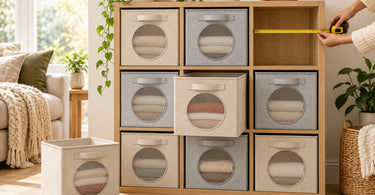
The most common storage mistake isn't choosing the wrong style. It's choosing the wrong size. A bin half an inch too wide won't slide into a cube shelf. One that's too short wastes space above it. And an under-bed container that catches on the bed frame stays under there forever.
The good news: getting it right takes a tape measure and about ten minutes. Here's how to size storage bins for the three places people use them most, plus a cheat sheet for what fits inside.
The golden rule: measure space first, then the stuff
It's tempting to start with what you want to store. Start with where it will live instead. The space sets the maximum size of the bin. Your belongings decide how many bins you need and which shape works best.
How to measure any storage space
You need three numbers, always in the same order: width × depth × height.
- Measure the opening, not the interior. Shelf lips, face frames, door frames, and bed rails are usually narrower than the space behind them. The narrowest point is your real limit.
- Measure in two or three places. Older shelves and floors aren't perfectly square. Use the smallest number.
- Leave clearance. Subtract about ¼ to ½ inch from the width so the bin slides without scraping. Leave at least an inch above it so you can tilt it out with something inside.
- Check for handles and lids. A side handle can add half an inch. A lid that opens upward needs room to open.
Write the numbers on your phone. You'll use them again every time you shop.
Sizing bins for cube shelves
Cube organizers are the most common place people get bin sizes wrong, because "cube shelf" doesn't mean one standard size. In the U.S., two sizes cover most of them:
| Cube shelf type |
Typical opening
|
Bin size to look for
|
|
IKEA Kallax and similar
|
About 13" wide × 13" tall × 15" deep
|
13" bins (IKEA's own Kallax boxes are 13" × 15" × 13")
|
|
Many compact cube organizers
|
About 11–12" wide × 11–12" tall
|
10.5–11" bins
|
Don't trust the product name alone. Two "cube organizers" from different brands can differ by two inches. Measure the opening, subtract your clearance, and compare it with the bin's exterior dimensions, not its interior.
Our fabric storage cubes come in 11-inch and 13-inch sizes with a round clear window, so you can match them to either type of shelf. The 13-inch size fits IKEA Kallax shelves, and both sizes are made of durable Oxford fabric with reinforced sides.
Sizing bins for closet shelves
Closet shelves are usually 12 to 16 inches deep, with plenty of height above them. Here the risks are different:
- Depth: A bin deeper than the shelf hangs over the edge, catches clothes, and gets knocked down. Choose bins at least an inch shallower than the shelf.
- Height: Tall bins on a high shelf are hard to see into and heavy to lift down. Two medium bins beat one giant one.
- Width: Measure the shelf length and divide by the bin width. Allow about an inch between bins so you can grab them.
For tips on what to put up there, see our guide to organizing a small closet.
Sizing bins for under the bed
Under-bed storage is all about one number: clearance.
- Measure from the floor to the lowest point of the bed frame. Check the side rail, any center support, and the slats.
- Subtract about an inch so the container slides easily, even on carpet.
- Measure the bed's depth from the side you'll pull from. Also note where the legs and center supports sit, because they decide how many bins fit side by side.
Many standard bed frames leave 6 to 8 inches of space underneath, which is why low-profile bins around 6 inches tall are the most popular size. Our under-bed storage bins are 33.7" long, 17.1" wide, and 6" tall, which works out to roughly 60 liters each. They have handles on three sides, so you can pull them out from the side or the foot of the bed. Each one is made from thick two-ply linen, a naturally breathable fabric that helps stored clothes and bedding stay fresh.
Size by what you're storing
Once you know the maximum bin size, match it to the contents. As a rule of thumb, a bin should be full but not stuffed. Overfilled fabric bins bulge and stop sliding. Half-empty hard bins waste space.
|
What you're storing
|
Bin size that usually works
|
|
Socks, underwear, scarves
|
Small cube (about 11") or a drawer insert
|
|
Folded T-shirts, leggings, kids' clothes
|
11–13" cube
|
|
Sweaters and jeans
|
13" cube, or a wide shelf bin about 8–12" tall
|
| Sheet sets and pillowcases |
Medium bin or under-bed container
|
|
Off-season clothing
|
Under-bed container, about 6" tall
|
|
Comforters, duvets, and blankets
|
Large storage bag, about 26" × 20" × 10"
|
|
Toys and craft supplies
|
13" cube with an open top or a window
|
For bulky bedding specifically, our guide to the best ways to store blankets covers folding, rolling, and why breathable bags beat vacuum bags.
What do liters actually mean?
Many bins list capacity in liters, which is hard to picture. Here's the quick conversion: multiply length × width × height in inches, then divide by 61.
- An 11" cube: 11 × 11 × 11 = 1,331 cubic inches, or about 22 liters.
- A 33.7" × 17.1" × 6" under-bed bin: about 57 liters.
If a listing gives liters but no dimensions, ask for the dimensions. Two bins with the same capacity can have completely different footprints.
Don't forget weight
Bigger isn't always better. A large bin full of books or shoes can become too heavy to lift safely from a high shelf, and fabric bins can bow under heavy loads. Keep heavy items in smaller bins on lower shelves, and save the big containers for light, bulky things like bedding and clothing. If you're unsure which material suits your load, read fabric vs. plastic storage bins.
Build a system, not a collection
The tidiest shelves use one or two bin sizes in one or two colors. Choose a size that fits your shelf, then buy enough of it to fill the whole unit. Matching bins line up, stack cleanly, and make a space feel calm, even when what's inside is anything but.
Frequently asked questions
What size bins fit a cube organizer?
It depends on the shelf. Kallax-style shelves take 13-inch bins. Many compact cube organizers take 10.5- to 11-inch bins. Always measure the opening and leave ¼ to ½ inch of clearance.
How much space do I need under my bed for storage?
Measure from the floor to the lowest part of the frame and subtract about an inch. If you have 7 inches, a 6-inch-tall container will slide in easily.
Should I measure the inside or outside of a storage bin?
Compare the bin's exterior dimensions with your space. Use the interior dimensions to check what fits inside the bin.
How many liters is a good size storage bin?
For shelves, 20 to 30 liters is easy to lift and fill. For under the bed or for bedding, 50 to 90 liters makes better use of the space.
Measure once, buy once. With your three numbers in hand, browse our fabric storage cubes and under-bed storage bins. Each listing gives exact exterior dimensions, so you can compare them with your shelf before you order.
